




Most women entrepreneurs I talk to want their businesses to feel more stable and manageable, and it usually comes down to one thing: their business systems aren’t built for how they work. It’s not a personal failure or a lack of organization; it’s just that their businesses have grown, and their systems haven’t kept up.
Running a service business means balancing client work, content, admin, communication, and every little decision that pops up throughout the day. Even when things are going well, it’s easy to feel like you’re moving through quicksand. Eventually, your setup starts to feel heavy and complicated, even if you’re someone who likes to stay organized (🙋🏻♀️).
You pick up new tools whenever you feel stuck; you keep old tools because switching feels daunting; you build temporary workarounds that work for a little while but then stop working once your client load grows. Before long, you’re jumping between platforms, repeating tasks, and trying to keep track of too many moving parts.
It happens slowly, then suddenly. And once it gets to that point, everything feels more difficult than it should be.
That’s why simplicity really matters. Not just as a buzzword, but as a genuinely supportive way to run a business that grows without causing you to burn out. When your systems are focused and intentional, you gain more time, your work feels clearer, and managing your business becomes easier.
When your systems get complicated, everything else does too
Most entrepreneurs end up with a cluttered tech stack without even realizing it. It happens one small decision at a time.
First, you add a scheduling tool because someone recommended it.
Then, you start using a free app for a task that your main tools can already handle.
Later, you watch a YouTube tutorial and think you need a new automation because someone else swears by it.
It might not seem like much at first, but after weeks or months, your daily workflow relies on tools that don’t talk to each other, processes that are inconsistent, and tasks that take more time and effort than they should.
This leads to things like:
- forgetting where a client file lives
- missing small follow-ups
- onboarding that feels disorganized
- emails slipping through the cracks
- updates taking longer than necessary
None of this means you’re scattered; it just means your systems aren’t supporting you.
Why simplicity makes growth easier
Simple systems don’t mean “basic” or “boring.” They mean intentional. They mean you’ve chosen the right tools and set them up in a way that matches how your business actually operates.
When your systems are clean and easy to follow, you:
- create a predictable client experience
- move through your workload with less friction
- take on more clients without overwhelming yourself
- keep your tasks and communication in one place
- spend more time on the work you’re great at
Simplicity reduces friction—it gives you clarity, and it makes growth feel steady instead of chaotic.
When the foundation of your business feels calm, everything you build on top of it becomes more stable.
What simple, scalable systems look like
Let’s walk through what this actually means in practice. These aren’t complicated steps; they’re simple changes that make your day feel easier and more predictable.
1. Audit your tools
Start by listing every tool you use. Even the small ones. Especially the small ones.
Look at:
- what you use regularly
- what overlaps
- what frustrates you
- what no longer fits your workflow
Most people are surprised by how long their list is.

2. Use one tool per purpose (or an all-in-one that truly works for you)
This is one of the easiest ways to simplify your business.
Examples:
- one scheduling platform
- one place where all client communication happens
- one invoicing and contract system
- one project management tool
- one email marketing platform
You don’t need multiple tools doing the same thing. You just need one tool doing that thing well.
Some platforms (like HoneyBook) can handle several of these functions for you. That’s great, as long as it actually fits your workflow and doesn’t add extra steps or make things more complicated. The goal here is to avoid using three different tools if one can handle everything you need.
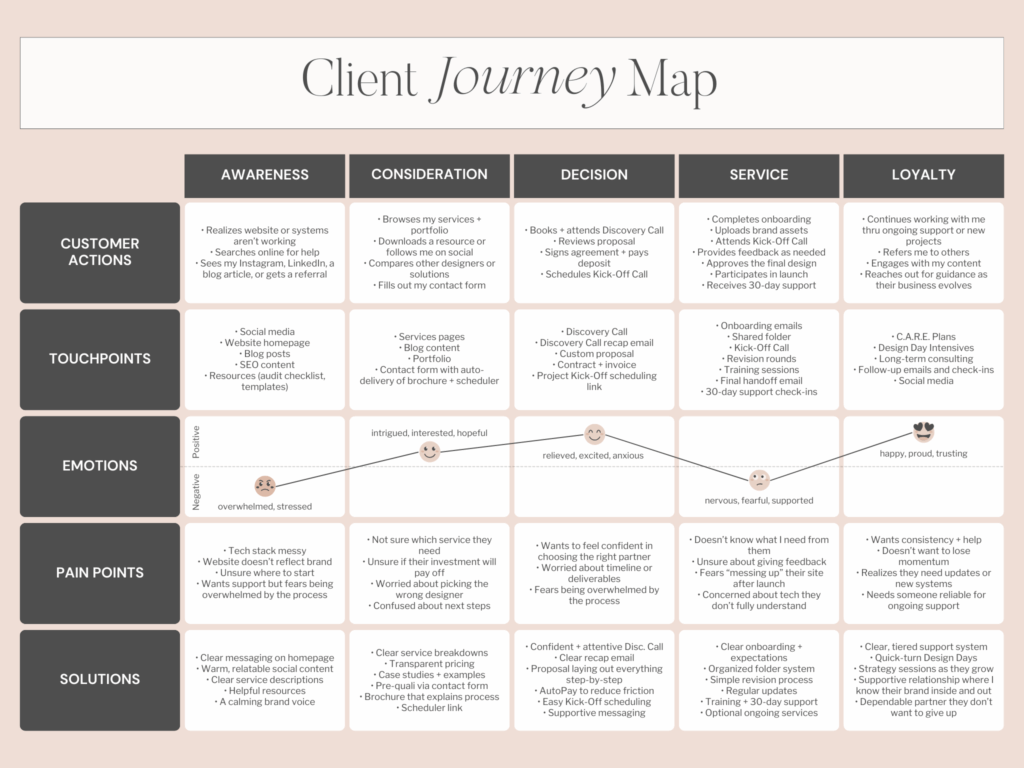
3. Map out your client journey step-by-step
Write out everything a client goes through. From the moment they inquire all the way through offboarding.
Then ask yourself:
- Where does this feel slow?
- Where do I repeat tasks?
- Where do clients seem confused?
- Where am I constantly playing catch-up?
A smooth client journey is one of the most crucial business systems for entrepreneurs because it affects time, boundaries, and revenue.
4. Automate the small, repetitive tasks
A lot of people think automation has to be complicated. It doesn’t.
Simple automations do the heavy lifting for you:
- confirmation emails
- reminder emails
- invoice reminders
- folder templates
- intake forms
- feedback requests
Choose automations that genuinely help your day feel smoother, not ones you’ll forget to maintain.

5. Build systems that match how you work
Your business is unique. Your systems should reflect that.
A new mom, a full-time therapist, and a brand designer all have different rhythms and capacities. What works for someone else might not work for you.
Your systems should support your natural workflow, not hinder it.
What happens when your business finally feels simple
Something shifts when your systems start supporting you instead of draining you. You feel more grounded, spend less time “managing” and more time actually working, keep up with client work because your workflow is clear, and move through your day with fewer decisions to make.
And there’s a real confidence that comes with simplicity. You understand where everything belongs. You know how your process works. You’re not constantly reinventing your workflow with each new project. And you don’t feel like you’re always playing catch-up.
Your business starts to feel like something you’re leading instead of something you’re chasing.
✨ Want support creating simple, sustainable systems?
If your business feels heavier than it should, you’re not alone. It’s completely normal to outgrow your setup. And sometimes, the quickest way to move forward is to clean up what you already have.
My System Setup & Integrations service helps you organize your tools, streamline your workflow, and build a supportive foundation for your business. No pressure; just clarity and practical support that fits the way you work.